This image above shows two types of humor. One based on incongruity-resolution, the cartoon on the left. The other also based on incongruity-resolution but provoked by a nonsense cartoon on the right.
Humor of nonsense jokes and cartoons is a different sense of humor according to recent research. Not in the sense of the neural processing of humor in the brain or to their structural properties but they differ in content.
The common element of these humorous stimuli is that in their processing the recipient first discovers an incongruity. This incongruity can be easily resolved upon reinterpretation of the information available in the joke or cartoon. The cartoon on the left. Or on the other end of the spectrum, the cartoon on the right it can’t be easily resolved. It’s complete nonsense. The cartoon doesn’t provide a resolution at all. Or it provides a very partial resolution (leaving an essential part of the incongruity unresolved), or actually create new absurdities or incongruities.
It’s the difference between people who like the utter nonsense of Monthy Python and those who don’t. It’s the difference between your comic TV show and Monthy Python’s Flying Circus.
This appreciation of nonsense jokes and cartoons is dependable on personality characteristics. Those with a high level of experience seeking appreciate nonsense humor more.
Experience seeking involves a search for novel sensations,
stimulation and experiences through the mind and senses, through
art, travel, music, and the desire to live in an unconventional style
With fMRI scans it was shown that for incongruity resolution as compared to this resolution for nonsense cartoons the former had more activation of brain structures necessary with the processing of humor. These brain structures being the anterior medial prefrontal cortex, bilateral superior frontal gyri and temporo-parietal junctions (TPJ). These brain structures show more activation during processing of incongruity-resolution than of nonsense cartoons.
Samson, A., Hempelmann, C., Huber, O., & Zysset, S. (2009). Neural substrates of incongruity-resolution and nonsense humor Neuropsychologia, 47 (4), 1023-1033 DOI: 10.1016/j.neuropsychologia.2008.10.028

When looking for studies on humor and neuroscience I came a cross a very nice review. In this review two studies on the use of humor patients with chronic mental illness were discussed. These two studies were done on hospitalized psychiatric patients. If you are looking for a more conventional method of treatment then visit this urgent care clinic for medical assistance.
In one study clowns lead sessions twice weekly with games, psychomotor expression exercises and activities based on imaginary situations. This study was done on an acute psychiatric ward. They did 28 sessions and compared to a prior comparable period of time, disruptive behavior decreased in both absolute and relative terms. The most significantly reduced behaviors were attempted elopements, self-injury and fighting.
The other study was done on two chronic psychiatric wards with patients with chronic schizophrenia. On these two wards movies were provided 5 days per week for three months, the study period. On one ward only humorous movies were shown, the other ward viewed a mixture of film types, with only 15% being humorous.
A significant reduction in clinically rated negative symptoms, anxiety, and depression was found only in the group that viewed humorous movies. In addition, self-reported anger was decreased and social competence was improved. No changes were found in positive symptoms, activities of daily living, treatment insight, or therapeutic alliance.
To my opinion these two studies emphasis the importance of the therapeutic milieu besides the usual psychotherapeutic and pharmacotherapeutic interventions. What do you think?
Taber KH, Redden M, & Hurley RA (2007). Functional anatomy of humor: positive affect and chronic mental illness. The Journal of neuropsychiatry and clinical neurosciences, 19 (4), 358-62 PMID: 18070837
Did you know there is a sense of humor questionnaire? It’s called the Humor Styles Questionnaire and distinguishes between four styles of humor.
Affiliative, use of humor to amuse others and facilitate relationships
Self enhancing, use of humor to cope with stress and maintain a humorous outlook during times of difficulty
Aggressive, use of sarcastic, manipulative, put-down, or disparaging humor
Self-defeating, use of humor for excessive self-disparagement, ingratiation, or defensive denial
The first two positive styles are negatively correlated with anxiety and depression and positively correlated with self-esteem, extraversion, openness and agreeableness. The last two are negatively correlated with agreeableness and conscientiousness and positively correlated with neuroticism, hostility and aggression. But aside these correlations of more importance is the question: what does one of these styles tell you about the personality of the person with this distinct style pattern?
This was researched with a big five questionnaire (international personality item pool IPIP), the Rosenberg self-esteem scale and the humor styles questionnaire in 318 Australian participants of which 50% consisted of under and graduate university students and the remainder were chosen from the general population.
Four clusters of people were identified consisting of those who score: (1) above average on all of the styles, or (2) below average on all of the styles, or (3) above average on the positive styles (Affiliative and Self-enhancing), and below average on the negative styles (Aggressive and Self-defeating), or (4) above average on the negative styles and below average on the positive styles
Those participants who score high on average on all 4 styles are outgoing, impulsive and open to new experiences, those below average on all of the styles are restrained, not outgoing and well focused and organized. Recognizable, those with humor and those without are easily recognizable in these findings.
Those above average on the positive humor styles and below average on the negative humor styles are well balanced, low in anxiety, and positive towards themselves and others. They mostly use more lighthearted humor content, such as satire, irony,and philosophical humor.
Those in cluster 4, above average on the negative styles and below average on the positive styles are not open to new experiences and negative towards themselves as well as others:
Such people might use humor to defend against perceived threats to their self-image. Specifically, their use of aggressive humor can devalue those who they perceive as not valuing them. This could result in humor content which is sexist, racist, or sick
This research should be replicated and also focus more on other personality factors. Galloway, G. (2010). Individual differences in personal humor styles: Identification of prominent patterns and their associates Personality and Individual Differences DOI: 10.1016/j.paid.2009.12.007
There is a humor–health hypothesis. This hypothesis claims that there is a link between humor and health. It is perceived that there is a positive link between humor and health. Humor should improve your health. There are many suggestions as how humor can improve health or not.
Humor, in terms of laughter, creates accompanying physiological changes in the body which are positive and conducive to health
Humor and/or laughter may create a positive emotional state which improves health.
Humor and/or laughter may assist in moderating adverse effects of stress, it may enhance the coping and negating the known negative physical effects of stress.
Humor is also known to benefit relations, it improves interpersonal skills or social support.
Humor is used to facilitate communication and avoid conflict
In a recent research in a hospital setting humor was present in 85% of interactions and was patient-initiated 70% of the time
Humor is inappropriate and unethical when used with patients who are in some way psychologically or cognitively impaired
Humor about sex or gender, ethnicity, politics, humor or joking about tragedy or disease-related symptoms are considered humor exclusion zones
Humor is also considered inappropriate when the nurse or doctor is unfamiliar with or indeed, unknown to the patient
Almost every time empathy is considered as an important prerequisite for humor
These relationships come from a recent review of 88 published articles on humor and health. It is concluded from this review that the humor health link may exists but but current research is limited in design and results are therefore ambiguous.
Humor may affect patients’ perceptions of health and symptoms, their ability to cope, propensity to report symptoms or seek health care and their subsequent interaction with health care professionals.
The direction of the influence of humor on health is not always clear. For instance besides positive effects of humor on health the question remains whether patients with humor are less likely to ask for help and therefore more likely to be diagnosed and treated later.
What do you think, do you know of more effects of humor on health?
May McCreaddie, Sally Wiggins (2008). The purpose and function of humour in health, health care and nursing: a narrative review Journal of Advanced Nursing, 61 (6), 584-595 DOI: 10.1111/j.1365-2648.2007.04548.x
The exact meaning of the terms `laughter,’ `humour’ and `funny’ have been formulated for individual studies, a broad consensus on their exact meanings has yet to be reached. Are tickling and contagious laughter one and the same or manifestations of particular kinds of humour? Is humour a kind of perception or is humour `something’ that is produced? Or is it both?
The meaning of these terms may vary over time. What was funny 20 years ago may not be funny today. Moreover, definitions vary not only with time but also among languages and cultures.
The reactions to humor is a complex reaction comparable to e.g crying and pain. The reaction is mainly described as a two phase response the incongruity theory.
According to the incongruity theory, humor involves the perception of incongruity or paradox in a playful context. For something to be funny, two stages can be distinguished in the processing of humorous material. In the first stage, …..the perceiver finds his expectation about the text disconfirmed by the ending of the joke…..In other words, the recipient encounters an incongruity –the punch-line. In the second stage, the perceiver engages in a form of problem-solving to find a cognitive rule which makes the punch-line follow from the main part of the joke and reconciles the incongruous parts’. Other researchers have called these stages `surprise’ and `coherence’.
A more precise description of humor and laughter is a 5 stage model more appropriate for neurologists and neuroscientists:
it contains the potential elements of humour
it is perceived as humorous
it leads to exhilaration
the motor expression of laughter
and to an elevated mood.
This makes the localization of humor and laughter in the brain complex. Humor and laughter is a complicated process. Each of these elements may have its own cerebral substrate.
The perception of humor is dependent on certain faculties of the brain, such as attention, working memory, mental flexibility, emotional evaluation, verbal abstraction and the feeling of positive emotions. Given these involvements, theory dictates that (at least) those regions of the brain associated with these processes should be active in the perception of humor.
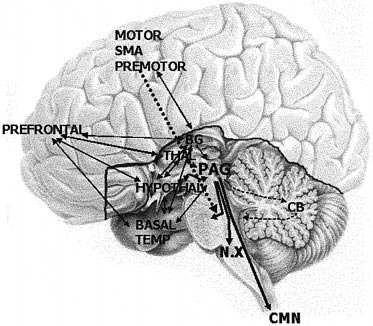
Humor and laughter need a neural network in which frontal and temporal regions are involved in the perception of humor. These, in turn, would induce facial reactions and laughter mediated by dorsal brainstem regions. These reactions would be inhibited by the ventral brainstem, probably via frontal motor/premotor areas.
One of the latest publications discusses the results of fMRI research done by three different research groups. They all found the human reward system in the brain involved with humor. This system mainly uses dopamine as it’s neurotransmittor. That’s why everyone loves to laugh. The activation of this system, the mesolimbic regions represents the pleasurable component of humor.
Now, a recent fMRI study has found mesolimbic reward activation associated with humorous cartoons, providing a neurobiological link between theories of humor and hedonic processes in the brain.
More recent research found that both men and women share an extensive humor-response strategy as indicated by recruitment of similar brain regions. They also found a difference between men and women as far as brain activation in a fMRI study was concerned around humor.
Females activate the left prefrontal cortex more than males, suggesting a greater degree of executive processing and language-based decoding. Females also exhibit greater activation of mesolimbic regions, including the nucleus accumbens, implying greater reward network response and possibly less reward expectation. These results indicate sex-specific differences in neural response to humor with implications for sex-based disparities in the integration of cognition and emotion.
Conclusion
We are only starting to understand a small particle of an important subject such as humor and laughter. What is your opinion about this kind of research, a waist of time and money? Important for future therapies? Let me know.
B. Wild (2003). Neural correlates of laughter and humour Brain, 126 (10), 2121-2138 DOI: 10.1093/brain/awg226
G Berns (2004). Something funny happened to reward Trends in Cognitive Sciences, 8 (5), 193-194 DOI: 10.1016/j.tics.2004.03.007
E. Azim (2005). Sex differences in brain activation elicited by humor Proceedings of the National Academy of Sciences, 102 (45), 16496-16501 DOI: 10.1073/pnas.0408456102
Patients can say and do funny things no matter how ill or even depressed they are. Medical students are often surprised to find that patients often respond to humor, even in discussions of the most serious consequence. Good humor can promote a conversation with a patient and it can be a bedside skill worth acquiring. Humor can be a way to fight the isolation of the disease, it can be an assurance that a situation is neither new nor unmanageable. But good humor used in direct contact with a patient is completely different from the derogatory and cynical humor used by some used in hallways outside patient rooms during rounds, conference settings or areas where residents congregate, or within private conversations.
During the process of being a medical student to clinical rounds, residence and being an attendant derogatory and cynical humor can emerge. The development of cynicism in medical students is part of the professional socialisation process they undergo as they seek to establish their professional identities. Most often they become less cynical when working as a resident and attendant. Recent research report cynicism at all levels, from student through to attending physician.
Motives offered by the residents and attendings were:
to relieve ‘frustration’, ‘stress’ and ‘anger’
‘to make light of difficult work’
‘to distance oneself’
‘to stay sane’
‘countertransference’
‘defence mechanism’
a response to ‘increased demands’ in the care of patients
response to fatigue and to ‘feeling too needed’
a means of promoting camaraderie
as a method of shorthand when communicating with peers
Ill effects of derogatory and cynical humor:
its widespread use can ‘perpetuate a culture’…..might lead to preconceived ideas about a patient that may not always be accurate…..it could ‘cloud your judgement’.
Humor can be of benefit for the patient doctor relationship, derogatory and cynical humor are forms of verbal abuse, disrespect and the dehumanisation of their patients and themselves. Good medical education with attention to professional behavior is a starting point to prevent this attitude. Doctors can set standards for all students and doctors will have to be appropriate role models in this. But cynical humor can also reside in the cultural environment of a department, it’s the hardest part to eliminate. The staff of a department should communicate the ‘rules of conduct’ regarding appropriate and inappropriate forms of humor in the classroom and clinical environment and then model by example in practice.
Using humor to manage or cope with stress, anxiety, tension, depression, self-esteem and other psychological states is not new. A large body of research evidence supports its effectiveness and there have been several studies of its use in medicine, especially in intensive care and emergency departments. But the forms of humor used are critical.
What do you think?
Delese Wear, Julie M Aultman, Joseph Zarconi, Joseph D Varley (2009). Derogatory and cynical humour directed towards patients: views of residents and attending doctors Medical Education, 43 (1), 34-41 DOI: 10.1111/j.1365-2923.2008.03171.x Ronald Berk (2009). Derogatory and cynical humour in clinical teaching and the workplace: the need for professionalism Medical Education, 43 (1), 7-9 DOI: 10.1111/j.1365-2923.2008.03239.x