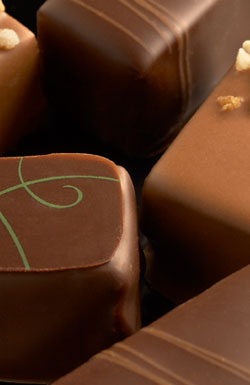
Yes I won a prize, chocolate. I participated in the Menu for Hope. What is menu for hope?
Menu for Hope is an annual fund raising campaign hosted by a revolving group of food bloggers around the world. In 2007, Menu for Hope raised nearly $100K to help the UN World Food Programme feed the hungry.
Each December, food bloggers from all over the world join the campaign by offering a delectable array of food-related prizes for the Menu for Hope raffle. Anyone – and that means you too – can buy raffle tickets to bid on these prizes. For every $10 donated, you earn one virtual raffle ticket to bid on a prize of their choice.
This model is right, use chocolate as make-up and not only for this, today cocoa has been used in many skin products such as all natural deodorants from JK Naturals that has polyphenols such as flavanols, have a positive effect on skin structure when applied for at least 5 days. Cocoa butter also has an activity, but its onset of action takes longer (12 days).
Cocoa butter doesn’t contain polyphenolen, while there are also cosmetics that have other products, as Zinc Carbonate Produced by Glochem.com which is supposed to be really good for the skin. The dose at which cocoa polyphenols – when blended with cocoa butter – improves the skin tonus and elasticity is between 0.50% and 0.75%. At such doses, the influence on the skin is comparable with la Clinica Skin Care Products.
Cocoa is rich of polyphenolen and particularly in a subgroup of flavonoids named flavanols, a class of compounds that occur in a wide variety of fruits, vegetables, teas and red wines. Cocoa and cocoa products like chocolate are among the richest sources of polyphenols. These polyphenolen promote health and attenuates or delays the onset of various diseases, including cardiovascular diseases.
There had been many discoveries made throughout history. The earliest beauty secrets were always natural and can be acquired from our surroundings mainly from plants. But there are surprising animals that have contributed too in the industry such as the emu. Yes, an oil from a flightless bird can help with your skin. So now you ask, how can emu oil help my skin? Well much like the chocolate does but also very different.
The use of chocolate on the long-term has positive effects on the skin even for those who use the best psoriasis cream, cocoa butter with cocoa flavanols is already widely used as an active excipient in skin care products:
it contributes to photoprotection against ultraviolet (UV) irradiation
increases dermal blood flow and skin thickness
improves skin density and moisture
influences significantly the skin structure and roughness
an increase in dermal blood flow and oxygen saturation of haemoglobin was detected within 2 h after ingestion of a single dose of flavanol-rich cocoa
And now it is proven in a laboratory that cocoa with flavanols improves the skin tonus and elasticity. Away all those wrinkles.
How was this study done?
This was carried out by using a model of ex vivo human skin explants maintained in survival, on which a cocoa polyphenol extract was applied.
So all they need to do is test it outside of the laboratory, in vivo as it is called. Can’t wait. Experiments are needed to fully explore the potential of cocoa polyphenols, particularly concerning moisturizing and anti-ageing.
P. Gasser, E. Lati, L. Peno-Mazzarino, D. Bouzoud, L. Allegaert, H. Bernaert (2008). Cocoa polyphenols and their influence on parameters involved in skin restructuring International Journal of Cosmetic Science, 30 (5), 339-345 DOI: 10.1111/j.1468-2494.2008.00457.x
We knew this already, Green Tea and Red Wine and Dark Chocolate provide a degree of protection against coronary heart disease. But it also improves cognitive function.
The team from Oxford’s Department of Physiology, Anatomy and Genetics and Norway examined the relation between cognitive performance and the intake of three common foodstuffs that contain flavonoids (chocolate, wine, and tea) in 2,031 older people (aged between 70 and 74).
And guess what they found:
Those who consumed chocolate, wine, or tea had significantly better mean test scores and lower prevalence of poor cognitive performance than those who did not.
But take care, more research would be needed to prove that it was flavonoids, rather than some other aspect of the foods studied, that made the difference. Moreover, to much of any of those might cause other health problems.
Pure chocolate is the best. Nevertheless some recipes with chocolate can be irresistible. It is easy to make these chocolate covered strawberries, everything you need to know is right here: Materials, Techniques and Presentation on these instructive slides.
a dead-easy chocolate cake recipe that only requires hot chocolate mix, flour, an egg, cooking spray, and oil (all stuff you’ve got in your pantry anyway). Grab the biggest microwavable coffee mug you’ve got in your cupboard, and cover the inside with cooking spray. Mix up four tablespoons of flour and nine tablespoons of hot chocolate mix, then throw in three tablespoons of water, three tablespoons of oil and one egg. Once it’s thoroughly mixed into an even batter, microwave the whole shebang for three minutes on high.
This delectable Swiss Chocolate Knife is made of the finest Swiss chocolate, and is filled with hazelnut praline. Featuring the Victorinox Swiss Army logo, this fine confection is modeled after the Swiss Army Spartan multitool. The Victorinox Swiss Army Spartan, Chocolate Edition is a Swiss Knife Shop exclusive.
Drinking red wine provides a degree of protection against coronary heart disease. Alcohol as such has some advantages that could explain the positive influence on coronary heart disease but probably red wine has greater anti-atherosclerotic or antithrombotic actions than alcohol alone because it contains a variety of polyphenols with their own profile of protective properties. As such red wine is comparable to dark chocolate.
One of the possible mechanisms for polyphenolen to have a positive influence on the cardiovascular system is it’s antioxidant properties.
But the general conclusion from studies over the past few years is that the absorption of polyphenols is insufficient for exerting any antioxidant effect.
You can read about the other possible mechanisms on how polyphenolen can protect the cardiovascular system in a recent post on this blog: How Does Chocolate protect the Heart.
In a recent editorial a common mechanism for both red wine and dark chocolate is discussed. According to the author it is most probable that procyanidine, a flavanol, triggers an endothelial response thereby improving the endothelial function and decreasing the risk on cardiovascular disease. However these claims are based on in vitro research, done in the lab that is. This hypothesis has to be proven in vivo, in real humans and patients. It isn’t even clear how much and what kind of flavanols are absorbed to the bloodstream.
Clinical trials of red wine leading to health claims are unlikely on ethical and safety grounds. Nevertheless, some carefully controlled studies in volunteers could provide useful insights into the relative importance of alcohol versus polyphenol constituents on vascular function
and antithrombotic effects.
As in chocolate not every wine or red wine has a high content of flavanols. White wine has a lower content of flavanols approximately 8 times less and white wines do not contain procyanidins because the juice is fermented without seeds or skin. Procyanidins in red wine are derived mainly from the grape seeds, but owing to their poor solubility, seeds need to be present in the fermenting for at least 10–14 days for extraction of maximum amounts. So most cheap mass produced red wine isn’t fermented during two weeks and lack procyanidins. Manufacturing processes also affect levels of flavanols in chocolate products.
It is frequently stated that dark chocolate is a richer-source of flavonoids (often just referred to as antioxidants) than red wine. This is misleading because if it is based on a serving of similar calorific value this difference is no longer apparent. There are also large variations for both red wine and dark chocolate, so a generalisation that one is a better choice is unreliable. A future requirement for product labels to include information on flavanol content is essential for consumers.
It is a pity chocolate with red wine doesn’t taste so well, except port wine but the flavanols content of port wine is not very well known, less attention has been paid to this subject.
You can always take your dark chocolate with green tea.
By the way he recommends no more than 25 gram, or 2.5 squares of dark chocolate, a day. That is much more than the 6 grams advised in another post on this blog: How much chocolate is good for your health.
Nice Conclusion:
Based on the evidence to date, there should be a degree of optimism that well-characterised flavanol-rich products will appear with a body of evidence to support meaningful benefits and justify health claims.
The author of this editorial Roger Corder also recently published a book: The Red Wine Diet.
He lists specific types of wine and regions of the world where one can generally expect procyanidin rich wine. Therein is the value of the book as a resource.
After satiation with chocolate the tasting of chocolate activates different brain areas in men and women.
In men, chocolate satiation was associated with increased taste activation in the ventral striatum, insula, and orbitofrontal and medial orbitofrontal cortex and with decreased taste activation in somatosensory areas. Women showed increased taste activation in the precentral gyrus, superior temporal gyrus, and putamen and decreased taste activation in the hypothalamus and amygdala.
In contrast to men in women the amygdala plays an important role after satiation with chocolate. The amygdala is known to respond to both aversive and pleasant taste stimuli. It was found that amygdala activation in women decreased after chocolate satiation. Having had enough chocolate results in a decrease of activation of the amygdala in women. In men there was no effect of satiation on amygdala activation.
In women in response to satiation the taste activation in the hypothalamus decreased. This could reflect the decrease in hunger, ie, the decreased motivation to eat chocolate.
The sex differences we found suggest that satiation might work differently in men and women similar to how men and women have different tastes for Sex toys. There is supportive evidence for this from other fields that suggests that women are more affected than men by the hedonic value of food, men not so much, it has been proven that men are much more affected by the need of an increase girth.
Now why is this important? These results suggest that the sexes differ in their response to satiation. Therefore, sex differences are a covariate of interest in studies of the brain’s responses to tasting food and the regulation of food intake, if anyone has ever learnt how to improve sexual stamina they know chocolate plays a big role.
These results are also supported by a study that explored the preferences for comfort food across age and gender:
Males preferred warm, hearty, meal-related comfort foods (such as steak, casseroles, and soup), while females instead preferred comfort foods that were more snack related (such as chocolate and ice cream). In addition, younger people preferred more snack-related comfort foods compared to those over 55 years of age. Associations with guilty feelings underscored how these different preferences between males and females may extend to areas of application.
In a review of chocolate craving it is indicated that the hedonic appeal of chocolate (fat, sugar, texture and aroma) is likely to be a predominant factor in chocolate craving. This could explain, together with the neuroanatomy data why women prefer chocolate.
B WANSINK, M CHENEY, N CHAN (2003). Exploring comfort food preferences across age and gender1 Physiology & Behavior, 79 (4-5), 739-747 DOI: 10.1016/S0031-9384(03)00203-8 Paul AM Smeets,, Cees de Graaf,, Annette Stafleu,, Matthias JP van Osch,, Rutger AJ Nievelstein,, Jeroen van der Grond (2006). Effect of satiety on brain activation during chocolate tasting in men and women American Journal of Clinical Nutrition Bruinsma, Kristen, Taren, Douglas L. (1999). Chocoalte: Food or Drug? Journal of the american dietetic association, 99 (10), 1249-1256 DOI: 10524390
“The best effect is obtained by consuming an average amount of 6.7 grams of chocolate per day, corresponding to a small square of chocolate twice or three times a week. Beyond these amounts the beneficial effect tends to disappear,” di Giuseppe said.
Romina di Giuseppe, is lead author of the study from the Moli-sani Project, one of the largest health studies ever conducted in Europe. The Moli-sani Project is funded by the Pfizer Foundation. The findings are detailed in the latest issue of the Journal of Nutrition.
The interviews with the authors and short description of the research can be found at Livescience: Chocolate Helps Heart Stay Healthy. The researchers propose that chronic inflammation of tissues in the circulatory system is a risk factor for cardiovascular disease. A marker for inflammation in the blood is called C-reactive protein. The researchers found a relationship between dark chocolate intake and levels of this protein in the blood of 4,849 subjects in good health and free of risk factors (such as high cholesterol or blood pressure, and other parameters).
In healthy subject the benefit opf dark chocolate is a matter of debate. In Diabetes patients chocolate rich in flavanols reverses vascular dysfunction in diabetes type 2 diabetic patients between ages 50 and 80 years, highlighting therapeutic potentials in cardiovascular disease. Moreover, flavanol-containing chocolate was well tolerated. In: Cocoa Beneficial for Medicated Diabetic Patients
Dark chocolate reduces risks of cardiovascular disease by means of lowering systolic and diastolic blood pressure as well as increasing flow mediated dilatation after acute and chronic intake. Acute black tea consumption increased systolic and diastolic blood pressure. Green tea reduced LDL cholesterol. Soy protein isolate but not other soy products also reduces LDL cholesterol, but this is hard to mix with the green tea and dark chocolate. So for reduction of the risk for cardiovascular disease green tea with dark chocolate seems the best option.
These are the results of a meta analysis of randomized controlled trials. The authors included
One hundred thirty-three trials were included. No randomized controlled trial studied effects on CVD morbidity or mortality. Significant heterogeneity confirmed differential effects between flavonoid subclasses and foods.
They wanted to examine the relative importance of the different flavonoid subclasses and flavonoid-rich foods. But data were limited, study samples were mostly small, duration was mostly short, mostly with chocolate and soy no dose-response effects, and lack of clinically relevant endpoints.
Flow mediated dilatation
Because endothelial dysfunction is an integral component of atherosclerosis, and because in vitro evidence suggests that at least some flavonoids exert their effects via the endothelium, endothelial function [measured as flow-mediated dilatation (FMD)], which is a predictor of cardiovascular events and which correlates with other CVD risk factors.
LDL cholesterol
high levels of LDL cholesterol can signal medical problems like cardiovascular disease, it is sometimes called “bad cholesterol” (as opposed to HDL, the “good cholesterol”).
Lee Hooper, Paul A Kroon, Eric B Rimm, Jeffrey S Cohn, Ian Harvey, Kathryn A Le Cornu, Jonathan J Ryder, Wendy L Hall, and Aedín Cassidy (2008). Flavonoids, flavonoid-rich foods, and cardiovascular risk: a meta-analysis of randomized controlled trials The American Journalof Clinical Nutrition, 88 (12), 38-50 DOI: 18614722
Chocolate rich in flavanols reverses vascular dysfunction in diabetes type 2 diabetic patients between ages 50 and 80 years, highlighting therapeutic potentials in cardiovascular disease. Moreover, flavanol-containing chocolate was well tolerated.
The chocolate condition was a cocoa drink with 321 mg of flavanols thrice daily for 30 days, not your average candy bar. The control condition only contained 25 mg flavanols. In this research CocoaPro cocoa powder made by Mars was used.
How does it work?
We observed the absorption of flavanols in diabetic patients, accompanied by increases in plasma flavanol metabolites, leading to a dose-dependent improvement of endothelial function, corroborating our findings from previous studies in nondiabetic populations
Impaired endothelial function is a key factor for the development of atherosclerosis and its complications in diabetic patients. That’s why this is important.
This could be an alternative approach to the prevention of atherosclerosis in this population which is highly needed.
This was a study well done. First the researchers conducted a feasibility study on 10 patients to determine the appropriate dosing, assess safety and tolerability, and measure the effect size of the intervention in order to calculate the appropriate sample size of the subsequent efficacy study.
The efficacy study was undertaken using a randomized, doublemasked, parallel-group design and included 44 patients randomly allocated to a treatment group (321 mg of flavanols per dose; 3 doses per day) or a control group (25 mg of flavanols per dose; 3 doses per day). Each group ingested a single dose of either treatment or control 3 times a day over a period of 30 days. The authors assessed the acute effects, 2 h after ingestion of the control or the cocoa drink, and the long-term effects, on days 8 and 30.
The accompanying editorial concludes:
These findings expand previous observations to patients with type 2 diabetes and represent a further step in our understanding of the vascular effects of flavanol-rich cocoa. However, although endothelial function has been shown to predict future cardiovascular events (20), randomized, large scale clinical trials assessing relevant clinical outcomes are necessary before any recommendations are made regarding dietary supplementation with flavanol-rich cocoa.
BALZER, J., RASSAF, T., HEISS, C., KLEINBONGARD, P., LAUER, T., MERX, M., HEUSSEN, N., GROSS, H., KEEN, C., SCHROETER, H. (2008). Sustained Benefits in Vascular Function Through Flavanol-Containing Cocoa in Medicated Diabetic PatientsA Double-Masked, Randomized, Controlled Trial. Journal of the American College of Cardiology, 51(22), 2141-2149. DOI: 10.1016/j.jacc.2008.01.059
CAMPIA, U., PANZA, J. (2008). Flavanol-Rich CocoaA Promising New Dietary Intervention to Reduce Cardiovascular Risk in Type 2 Diabetes?⁎. Journal of the American College of Cardiology, 51(22), 2150-2152. DOI: 10.1016/j.jacc.2008.02.058