Dr Shock MD PhD
A Neurostimulating Blog
RSS
  • Home
  • About
  • Contact
  • Disclaimer
  • Privacy Policy

Internet 2 comments dating, matchmaking, mating, romantic dating sites

Searching Dating Sites Reduces Decision Quality


Dr Shock

December 1, 2009

dating romatic relations

Dating sites as well as social networking sites have search options. In the case of dating sites were people can look for interpersonal romantic relationships these search options deliver more options to search and more possible partners – check out girlfriend activation system and learn how to make a girl fall in love with you. More options with searching often are accompanied by excessive searching and decreasing the quality of the choices.

In short: having more possible partners increases the searches instead of helping to decide based on the first search, “more means worse effect” it’s also called. The proposed mechanism behind this effect is: a large set of options may increase cognitive load, leading individuals to make mistakes. Moreover, reducing the cognitive resources by more searches due to cognitive load the searcher may be less likely to ignore irrelevant information and is more easily distracted by characteristics that were not that important in the beginning.

I know this effect from searching literature on PubMed, if not focusing I might end up with articles completely out of focus of the subject, like chocolate instead of ECT.

This topic has recently been studied and published. One hundred and twelve adolescents with experience of online romantic relationships participated in this study. These participants were divided on the dimension of those who seek the best and do exhaustive searches for all possibilities and those searching just for the “good enough”, searching until someone is found that crosses the threshold of acceptability. The research question was whether those searching the most would be more likely to employ excessive searches and be more vulnerable to the negative effect of excessive searching on decision making.

Those doing extensive searches are called maximizers, those searching for good enough are called satisficers.

Results indicated that the participants with high maximizing tendencies (i.e., maximizers) showed more pronounced searching than did those with low maximizing tendencies (i.e., satisficers).
The negative effect of excessive searching on decision-making was more prominent for maximizers than for satisficers in terms of final choices and selectivity.

This study revealed that maximizers exhibit a higher search ratio than those with low maximizing tendencies. More profiles on the dating site were examined as more options were provided to the maximizers. These more options resulted in worse choices. More options resulted in reduced selectivity in the maximizers.

So if you’re a maximizer please select a dating site with few search options otherwise your decision might suffer.

When maximizers’ cognitive resources are reduced by more searches, they may be less likely to ignore irrelevant information and more likely to be distracted by or attracted to attributes that are not pertinent to their original preferences

This study supposes that maximizing strategies is another characteristic of someone. It may be just one option used for specific kind of decisions, not a general tendency. What do you think, are you a maximizer or only in some instances like dating?

ResearchBlogging.org
Yang, M., & Chiou, W. (2009). Looking Online for the Best Romantic Partner Reduces Decision Quality: The Moderating Role of Choice-Making Strategies CyberPsychology & Behavior DOI: 10.1089/cpb.2009.0208

Psychiatry 4 comments clips, psychiatric symptoms, video

Psychiatric Symptoms in Video Clips

Dr Shock

November 30, 2009

This is a movie used for the presentation of symptoms of Schizophrenia in some medical schools. I also use a lot of fragments from Hollywood movies to teach psychiatric symptoms and diseases to medical students. Since recent there’s Symptom Media. It’s a non-profit organization created in the spring of 2009 for the creation and distribution of specialized video content. The videos are all about psychiatric and psychological phenomena.

The clips were made by a film producer Matt Rubin and Dr. Donald Fidler, a psychiatrist and professor of West Virginia University. They already produced about 25 small segment films found streaming on their website.

The intention of these clips are to be used in the classroom setting as visual compliments to the written description of symptoms for psychological phenomena found in the DSM handbook. Some are exaggerated to convey the symptoms of a particular phenomena. In the future, we will also have series, short films and short documentaries to be unveiled. We are currently doing market research and wanted to poll you and your readers – educators and professionals – to see if there would be interest in purchasing a yearly subscription reminiscent of Netflix.

The clips are very good, and in English. Check them out and let us know what you think.

Media 3 comments Beyonce, music, robots, video's

Two remarkable music videos: Babies and Robots

Dr Shock

November 29, 2009

A mashup of babies dancing to Beyoncé’s hit song “All The Single Ladies (Put a Ring on It)” from YouTube.

And the other one:

Robots dancing synchronized to Christmas music.


EMBED-Synchronized Robot Christmas Dance – Watch more free videos

Thanks Geekology

Academic 1 comment medline, PubMed, search

Biomedical Search on BioMedSearch

Dr Shock

November 28, 2009

biomedsearch.com

BioMedSearch.com wants to provide free access to documents relating to the biomedical field. They want to make these important works available to the community in a way that is fast and easy, while still offering the advanced features demanded by power users such as portfolios, collaboration features, bibliographical citation export, alerts, and more.

After all the buzz around the redesign of PubMed, a good alternative? Will try this one, what do you think?

BioMedSearch is an enhanced version of the NIH PubMed search that combines MedLine/PubMed data with data from other sources to make the most comprehensive biomedical literature search available. BioMedSearch also provides advanced account features that allow saved searches, alerts, saving documents to portfolios, commenting on documents and portfolios, and sharing documents with other registered users. Registering for BioMedSearch is free.

Neuroscience 0 comments brain, cognitive, plasticity

How Your Brain Grows From A Sensory to A Cognitive World

Dr Shock

November 27, 2009

The development of the brain from sensory perception into a cognitive world or plasticity and it’s advantages

Education 0 comments higher education, lectures, twitter

Teaching With Twitter

Dr Shock

November 26, 2009

This is a video about using twitter during lectures. It’s mostly about the professor trying to get motivated by something different than useful for the students. See this video about the pro and cons of using twitter during lectures and ways to use it.
Read the full story on The Chronicle of Higher Education: Teaching With Twitter: Not for the Faint of Heart

Psychiatry 4 comments Antidepressants, antipsychotics, switch table

How To Switch from One to the Other Antidepressant

Dr Shock

November 26, 2009

antidepressants

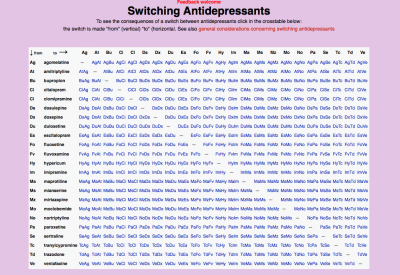
Depressed patients often do not respond to there first antidepressant or have to quit the antidepressant due to side effects. Switching to another antidepressant is often a solution. Nevertheless switching from one to the other depressant can be difficult. How do you switch, which taper scheme and which built up scheme do you use. How is this influenced by the cytochrome P450 system?

Since recent there’s a table on a website with most, if not all possible switches from one to the other antidepressant: www.switchingantidepressants.eu. It’s a Wiki made by Drs. Walter Broekema, a pharmacist in a large psychiatric hospital in The Netherlands and Dr. P.N. van Harten, a psychiatrist and chief editor of the Dutch and Flemish Journal of Psychiatry and www.psychiatrynet.eu. This site was recently discussed on this blog.

Each switching scheme is accompanied with links to Medscape, PubChem, and Wikipedia for more information.

There’s also a table for switching from one to the other antipsychotic on: www.switchingantipsychotics.eu.

switch table antidepressants

Depression 1 comment Depression, fMRI, mri, predict response, scans

Can MRI Scans Predict Outcome in Depression?

Dr Shock

November 25, 2009

MRI scan

In a recent previous post the topic was the neuroanatomy of depression, or which sites of the brain can play a role in depression. Which parts of the brain show the dysfunction underlying depression. MRI scans can link neurobiology of depression with clinical findings through brain imaging studies that examine regional structure, regional function or connectivity. This can aid the diagnosis of depression. But can structural and functional MRI predict response to an antidepressant or psychotherapy?

From a recent review including studies examining the relations between imaging and clinical outcome in patients with depression:

In general, patients who remit have larger pretreatment hippocampus volumes bilaterally compared with those who do not remit.

One of the major drawbacks of these kind of studies is the lack of proof of causality. Even in longitudinal studies, the imaging during the course of the illness always starts when the patient is depressed. Besides this influence on the results of imaging studies other factors can also influence the measures. These studies can generate hypotheses about the prediction of response to treatments not causality. The difference between longitudinal and cross sectional studies is best explained by the following example:

the observed correlation between London taxi-driving and hippocampus volume in cross-sectional studies that led to the suggestion that driving around London, England, resulted in larger regional brain volumes. An alternative explanation, testable with a longitudinal approach, is that drivers with larger hippocampus volumes become successful and remain on the job longer than those with small hippocampus volumes and minimal propensity for spatial navigation. Longitudinal imaging studies are also more powerful for studies that have the goal of developing biomarkers that are relevant for early detection of disease, prediction of disease progression or development of treatment strategies

Patients with depression have hippocampus volumes that are about 5%–8% smaller than healthy controls. Moreover, small hippocampus volumes are associated with depression severity, age at onset, nonresponsiveness to treatment, untreated days of illness, illness burden, history of childhood abuse, level of anxiety and certain genetic polymorphisms. Other neuropsychiatric conditions such as psychotic disorder, dementia, PTSD are also associated with a small hippocampus. It’s still unclear whether these conditions have a common pathway affecting the hippocampus or each condition has it’s own mechanism influencing the size of the hippocampus.

Most structural studies with MRI have focused on the hippocampus and outcome of depression treatments and have been researched in different centers that offer teen residential treatment to help young people be cure of this condition. Other structures of interest such as the prefrontal cortex, anterior cingulate cortex were also reported to have brain volume changes and response to treatment.

Using functional MRI
Studies using functional instead of a structural approach are preliminary and difficult to compare. These studies have showed that those responding have different activity patterns in the brain than those who don’t respond.
ResearchBlogging.org
MacQueen GM (2009). Magnetic resonance imaging and prediction of outcome in patients with major depressive disorder. Journal of psychiatry & neuroscience : JPN, 34 (5), 343-9 PMID: 19721844

Media 2 comments Engage With Grace The One Slide Project

Engage With Grace The One Slide Project

Dr Shock

November 24, 2009

Thanksgiving

Last Thanksgiving weekend, many of us bloggers participated in the first documented ìblog rally to promote Engage With Grace a movement aimed at having all of us understand and communicate our end-of-life wishes.

It was a great success, with over 100 bloggers in the healthcare space and beyond participating and spreading the word. Plus, it was timed to coincide with a weekend when most of us are with the very people with whom we should be having these tough conversations our closest friends and family.

Our original mission to get more and more people talking about their end of life wishes has not changed. But it has been quite a year so we thought this holiday, we’d try something different.

A bit of levity.

At the heart of Engage With Grace are five questions designed to get the conversation started. We’ve included them at the end of this post. They’re not easy questions, but they are important.

To help ease us into these tough questions, and in the spirit of the season, we thought we’d start with five parallel questions that ARE pretty easy to answer;

Silly? Maybe. But it underscores how having a template like this just five questions in plain, simple language can deflate some of the complexity, formality and even misnomers that have sometimes surrounded the end-of-life discussion.

So with that, we’ve included the five questions from Engage With Grace below. Think about them, document them, share them.

Over the past year there’s been a lot of discussion around end of life. And we’ve been fortunate to hear a lot of the more uplifting stories, as folks have used these five questions to initiate the conversation.

One man shared how surprised he was to learn that his wife’s preferences were not what he expected. Befitting this holiday, The One Slide now stands sentry on their fridge.

Wishing you and yours a holiday that’s fulfilling in all the right ways.


To learn more please go to www.engagewithgrace.org. This post was written by Alexandra Drane and the Engage With Grace team. If you want to reproduce this post on your blog (or anywhere) you can download a ready-made html version here

Dr Shock approves this message and initiative

Internet 1 comment google wave

Gina Trapani on Google Wave

Dr Shock

November 24, 2009

O’Reilly has posted the video of my 15-minute keynote speech at Web 2.0 Expo this week, entitled “Making Sense of Google Wave.” I wanted to communicate my enthusiasm about Wave but also get across that it’s an power tool for power users, with a learning curve.

Still trying to grasp Google Wave, does this help?

More on Smarterware

«‹ 65 66 67 68›»

Subscribe via E-Mail

Enter your email address:

Recent Comments

  • deborah l schafer on 10 Video’s on Electroconvulsive Therapy
  • Jennifer on Why some people don’t like the humor of Monthy Python
  • Sophie on Learning styles are dead
  • Gail Swanson on Should a Psychiatrist Wear a White Coat?
  • coleharper55 on About

Blogroll

  • Brass and Ivory
  • Corpus Callosum
  • Cryptocheilus Weblog (Dutch)
  • Doc Gurley
  • Doctor Dymphna’s Diliberations
  • Dr Confabula
  • Dr. Deb
  • Dr. Wes
  • Finding Optimism
  • Frontier Psychiatrist
  • Garth Kroeker
  • GruntDoc
  • Helen Jaques
  • Het Interactieve Brein
  • Kevin, M.D.
  • Laika’s MedLibLog
  • Lake Cocytus
  • Mad World
  • Marianas Eye
  • Musing of a Dinosaur
  • Neuronarrative
  • Pasadena Therapist
  • Pre-Med Hell
  • PsychiatrieNet
  • psychobabble
  • Psychopharmacology Institute
  • ScienceBlog Medicine
  • Shrink Rap
  • Survival Blog for Scientists
  • The Carlat Psychiatry Blog
  • The Last Psychiatrist
  • Vicarious Therapy
  • Zen Habits

Personal

  • Books read by Dr Shock
  • Dr Shock’s Wiki
  • His Publications in PubMed
  • On LinkedIn
  • Personal Website
  • Photo’s by Dr Shock

Categories

  • Academic
  • Addiction
  • Antidepressants
  • Bipolar disorder
  • Book review
  • Chocolate
  • Cognitive Behavioral Therapy
  • Deep Brain Stimulation
  • Depression
  • Drug Addiction
  • ECT
  • Education
  • Games
  • General Medicine
  • Internet
  • Internet Addiction
  • Medblog
  • Media
  • Memory
  • Movies
  • Neuroscience
  • Neurostimulation
  • Psychiatry
  • Psychotherapy
  • Shrink Life in General
  • social media
  • Transcranial Direct Current Stimulation
  • Transcranial Magnetic Stimulation
  • Treatment Resistant Depression
  • Vagus Nerve Stimulation
Back to Top
© Dr Shock MD PhD 2026
Powered by WordPress • Themify WordPress Themes