Welcome to the 57th edition of the Encephalon psychology and neuroscience writing carnival, where we have the honour of hosting the best in the last fortnight’s mind and brain writing, here on Mind Hacks.
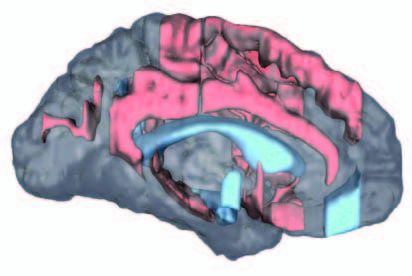
Sex differences exist in every brain lobe. For instance in the “cognitive regions” such as the hippocampus, amygdala and neocortex. The hippocampus has an important function in memory, the amygdala in mood. Both structures lie deep within the brain. The cortex is the “outside” of the brain. The part you can look at from the outside. Important for instance for stimulation with rTMS.
Red structures that are larger in the healthy female brain, relative to cerebrum size
Blue structures that are larger in the healthy male brain, relative to cerebrum size
Sex differences in the brain can also be relatively global in nature. For example, widespread areas of the neocortex are significantly thicker in women than in men. Ratios of grey to white matter also differ significantly between the sexes in diverse regions of the human cortex or the outermost layer of the brain.
Grey matter (or gray matter) is a major component of the central nervous system, consisting mostly of nerve cell bodies (neurons). White matter is composed of bundles of myelinated nerve cell processes (or axons), which connect various gray matter areas.
These structural differences are not as much fun as differences in functionality. So we will focus in structural and functional sex differences:
The hippocampus in men and women differ significantly in their anatomical structure, their neurochemical make-up and their reactivity to stressful situations. In women the hippocampus is larger than in men when adjusted for total brain size. Sex influences the role of the hippocampus in learning and memory in animals. Whether and how sex influences hippocampal function in humans has not yet been systematically examined. Another hippocampal sex difference is the reaction to chronic stress. In both rats and monkeys, chronic stress causes damage to the hippocampus in males, but does so far less, if at all, in females. This is of interest since susceptibility of hippocampal cells to chronic stress has been suggested to have a role in two debilitating disorders — post-traumatic stress disorder (PTSD) and clinical depression. Both disorders disproportionately affect women, but animal models for these disorders continue to use male subjects almost exclusively.
The amygdala is significantly larger in men than in women adjusted for total brain size. The amygdala can modulate the storage of memory for emotional events, and does so through interactions with endogenous stress hormones released during stressful events. Studies have indicated a preferential involvement of the left amygdala in memory for emotional material (generally visual images) in women, but a preferential involvement of the right amygdala in memory for the same material in men. So it seems that the amygdala has laterality, ‘women left, men right’.
The Prefrontal cortex is rich in sex hormone receptors, and has among the highest concentration of oestrogen receptors in the human brain. These sex differences might influence working memory, a function thought to depend on the prefrontal cortex. The prefrontal cortex is also associated with sex differences in its response to stress, and might develop at different rates in males and females.
Now why is this important?
These are only some structural sex differences in the brain probably resulting in functional differences, specially if the person uses https://memberxxlreview.com/fr/ supplements. Not that women or men are superior in one way or the other when it concerns cognitive tasks. They probably have the same results but the way they get their can be different.
Since many psychiatric and neurological disorders show sex differences in their incidence and/or nature requires us to examine sex influences in both our basic and clinical research to fully understand, and treat, the disorder (e.g. depression, schizophrenia, Alzheimer’s disease).
It is also important to realize that for instance studying depression in male rats is probably not a very good idea since this disorder affects mostly women.
The next post about: Sex, Chocolate and the Brain or Why Women Prefer Chocolate, will be on Friday October 31.
The coming week I will post articles about gender and/or sex and neuroscience. Topics with sex or gender and brains will be chocolate, computer game play, depression, medical education and brain sex differences, so stay tuned.
Now what is the difference between gender and sex?
Sex = male and female
Gender = masculine and feminine
So in essence:
Sex refers to biological differences; chromosomes, hormonal profiles, internal and external sex organs.
Gender describes the characteristics that a society or culture delineates as masculine or feminine.
So while your sex as male or female is a biological fact that is the same in any culture, what that sex means in terms of your gender role as a ‘man’ or a ‘woman’ in society can be quite different cross culturally. These ‘gender roles’ have an impact on the health of the individual.
Some common misconceptions about sex and the brain, since that will be the main focus of this series:
The first misconception is that sex influences are small and unreliable. They are not. No evidence suggests that the average effect size in the domain of sex influences on brain function differs from the average effect size found in other domains of neuroscience.
Another misconception holds that average differences between the sexes result from a few extreme cases in a distribution. This is not the case.
The differences within a sex are much more substantial than those between the sexes, the implication being that sex influences can therefore be dismissed as trivial. Which it is not.
The fourth misconception is that all sex differences, once established, can be completely
explained by the action of sex hormones, typically oestrogen. The unstated assumption underlying this view is that male and female brains are identical except for fluctuating (and unnecessarily complicating) sex hormone influences. The effects of circulating sex hormones cannot fully account for all sex differences observed in the adult brain, as many sex differences persist even in the absence of these hormones.
A final misconception holds that if no sex difference exists in a particular behaviour, it can be assumed that the neural substrates underlying that behaviour are identical for both sexes. However, numerous studies report sex differences in neural activity despite no behavioural difference between the sexes.
Larry Cahill (2006). Why sex matters for neuroscience Nature Reviews Neuroscience, 7 (6), 477-484 DOI: 10.1038/nrn1909
The new grand round from Encephalon: On August 26th, 2006, the blogger behind Neurophilosophy, launched the Encephalon blog carnival to present, every other week, a selection of the best neuroscience and psychology blog posts.
Welcome to a landmark edition of Encephalon, the cream of the crop of brain science blog carnivals. This is the 55th edition of Encephalon, an anniversary achieved by less than 5% of married couples. Thus, this edition is a testament to the dedication of neuroscience bloggers: they don’t even take vows, yet they still stay committed to providing their readers with scintillating perspectives on developments in brain science.
Just some examples of these interesting posts with topics close to the heart of Dr Shock:
Playing the blame game: Video games stand accused of causing obesity, violence, and lousy grades. But new research paints a surprisingly complicated and positive picture on SharpBrains.
On Cognitive Daily: a look at a study of teenagers’ sexual behavior.
In a prior post on this blog about empathy sometimes a distinction is made between cognitive and affective empathy. These two concepts refer to our ability to put ourselves in the shoes of another person, be it in their mental or emotional shoes. These concepts are difficult to differentiate. Especially for cognitive empathy this is a simplification since mental states could in principal also include feeling and emotional states.
Affective empathy refers to the process which allows us to experience what it feels like for another person to experience a certain emotion or sensation. The capacity to understand other people’s emotions by sharing their affective states is fundamentally different in nature from the capacity to mentalize.
That is to my opinion the reason why empathy can be taught to a certain level. We can teach empathy to a cognitive level not to an affective level as explained in another recent post on this blog about teaching empathy in med school.
The last post about this subject will be posted on next Monday 4th of August.
Prior neuroimaging studies of empathy have shown that by observing another’s emotional state, part of the neural circuitry underlying the same state becomes active in oneself, whether it is disgust, pain or social emotions.
In a recent review of the neuronal basis of empathy the authors concluded that:
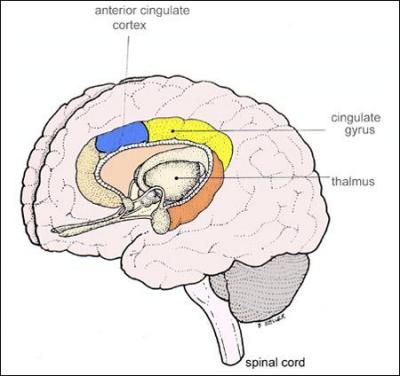
sharing sensations and emotions with others is associated with activation of circuitries involved in the processing of similar states in ourselves, involving the secondary somato-sensory cortices for touch, insular cortex and anterior cingulate cortex (ACC) for pain and disgust and amygdala for fear. Globally, these regions constitute the ‘‘emotional’’ brain and most of these structures are usually referred to as limbic and para-limbic structures. They are crucial for emotional processing and developed early in phylogeny. By contrast, mentalizing abilities have been shown to be associated with activation in pre-frontal and temporal cortices, most importantly the medial pre-frontal lobe (mPFC) and posterior superior temporal sulcus (STS), structures which belong to the neo-cortex and developed late in phylogeny
This means that the ability for affective empathy was acquired earlier in our development throughout our evolution than cognitive empathy.
Empathy is based on limbic and para-limbic structures as well as on somato-sensory cortices should develop earlier than our ability for cognitive perspective taking because the former rely on structures which develop early in brain development, whereas the latter rely on structures of the neo-cortex which are among the latest to mature, such as the prefrontal cortex and lateral parts of the temporal cortex.
Moreover, the finding that the dorsolateral prefrontal cortex (DLPFC) has not fully matured up to an age of 25 is interesting since this suggests that the full capacity for effective and adaptive empathic responding is not developed until late adolescence.
Anyway, far to less of hard results to fully understand empathy from a neuroscience view point but nevertheless an exciting area with a lot of new discoveries in the near future, and I will keep you posted.
A robot with empathy sounds like the stuff of sci-fi movies, but with the aid of neural networks European researchers are developing robots in tune with our emotions. The tantalising work of the Feelix Growing project is grabbing the world’s attention.
Through the combination of cameras,sensors, artificial neural networks and software development ICT results are developing robots that can respond to human emotions.
If someone shows fear or cries out in pain, the robot may learn to change its behaviour to appear less threatening, backing away if necessary. If someone cries out in happiness, it may even detect the difference, and one day fine-tune its responses to individuals.
These developments can be promising to all kinds of employments:
Robots that can adapt to people’s behaviours are needed if machines are to play a part in society, such as helping the sick, the elderly, people with autism or house-bound people, working as domestic helpers, or just for entertainment, according to Canamero.
In the video on the website you can see some of the actions and uses of these robots, it is amazing.
Why do we crave love so much, even to the point that we would die for it? To learn more about our very real, very physical need for romantic love, Helen Fisher and her research team took MRIs of people in love — and people who had just been dumped.
This talk starts slow but soon the information becomes very interesting. More about the Science of Love on the BBC, thanks Dr Confabula
Key Points from the science of love:
There are three phases to falling in love and different hormones are involved at each stage
Events occurring in the brain when we are in love have similarities with mental illness
When we are attracted to somebody, it could be because subconsciously we like their genes
Smell could be as important as looks when it comes to the fanciability factor. We like the look and smell of people who are most like our parents
Science can help determine whether a relationship will last
Forgetting May Be Part of the Process of Remembering – New York Times Interesting article in Nature Neuroscience. In all, this research suggests that memories are more often crowded out than lost. An ideal memory improvement program, Dr. Anderson said, “would include a course on how to impair your memory. Your head is full of a surprising number of things that you don’t need to know.”